The Practical Household Resilience Plan
Most families are one blackout, one layoff, or one brutal grocery month away from panic.
The prepared ones aren't lucky — they followed a plan. This is that plan: 20 chapters, one weekend, built in the order experienced preparedness communities keep recommending. Money first. Then food and water. Then power. Then your family's quiet basics. No bunker. No buckets. No doomsday.

A story about your street
It's 9:47 PM on an ordinary Tuesday when your lights blink once — and go dark.
The router dies mid-episode. The fridge stops humming. Someone's phone is at 12%. Nothing dangerous has happened — but the next 12 hours of your family's life were already decided, before the lights went out.
You're opening the fridge "just to check." Every time that door opens, you're spending food. There's an exact number of safe hours published by the USDA — do you know it? The families who do lose a few dollars tonight. The families who don't lose the whole freezer.
Whose phone stays on? Is the car charger where you think it is? Who's texting grandma that everyone's fine — and on what battery?
The house is getting cold. And somewhere on your street, someone is about to make the one mistake tonight that isn't about money — they're about to bring a generator or a charcoal grill inside. The safety agencies repeat the same rule every single winter, because every single winter, families ignore it.
Coffee or no coffee. Work call or no work call. Insulin still cold — or not. By breakfast, your plan (or your lack of one) has been graded.

A blackout may be the cheapest emergency your family faces this decade.
Look inside — actual pages
Don't take our word for it. Inspect the pages.
These are real, unedited samples from the book and its bonuses — click any page to read the full sample.
The Load Audit
How much energy does your house actually need per day? Do the worksheet before you shop — the number decides, not the ad.
| Device | W | Hrs | Wh |
|---|---|---|---|
| Phones × 2 | 10 | 3 | 60 |
| Router + modem | 15 | 12 | 180 |
| CPAP | 40 | 8 | 320 |
| Box fan | 60 | 6 | 360 |
| Total | 1,000 |
The Load Audit — your backup-power number in 3 questions
The food clock & the CO card
| Appliance | Safe for |
|---|---|
| Refrigerator | ~4 hours |
| Freezer, full | ~48 hours |
| Freezer, half | ~24 hours |
The Blackout Playbook — the whole night on one printable sheet
Week 1 — The base ($8.80 est.)
| Item | Size | Est. |
|---|---|---|
| White rice | 5 lb | $4.00 |
| Dried pinto beans | 2 lb | $2.50 |
| Iodized salt | 26 oz | $0.70 |
| Canned vegetables | 2 × 15 oz | $1.60 |
Pantry so far: ~6 days of meals for 1 adult · ~1½ days for 4.
The Pantry Builder — 12 weeks, ~$10 a week, food you already eat
Your Real Number
Almost nobody knows the number that actually matters in an emergency: what one month of your life costs, stripped to essentials.
| # | Essential | $ |
|---|---|---|
| 1 | Rent / mortgage | $ |
| 5 | Groceries (baseline) | $ |
| 16 | Annual bills ÷ 12 | $ |
| YOUR REAL NUMBER | $ |
A real chapter — 45 minutes, one worksheet, one number
Your First Weekend
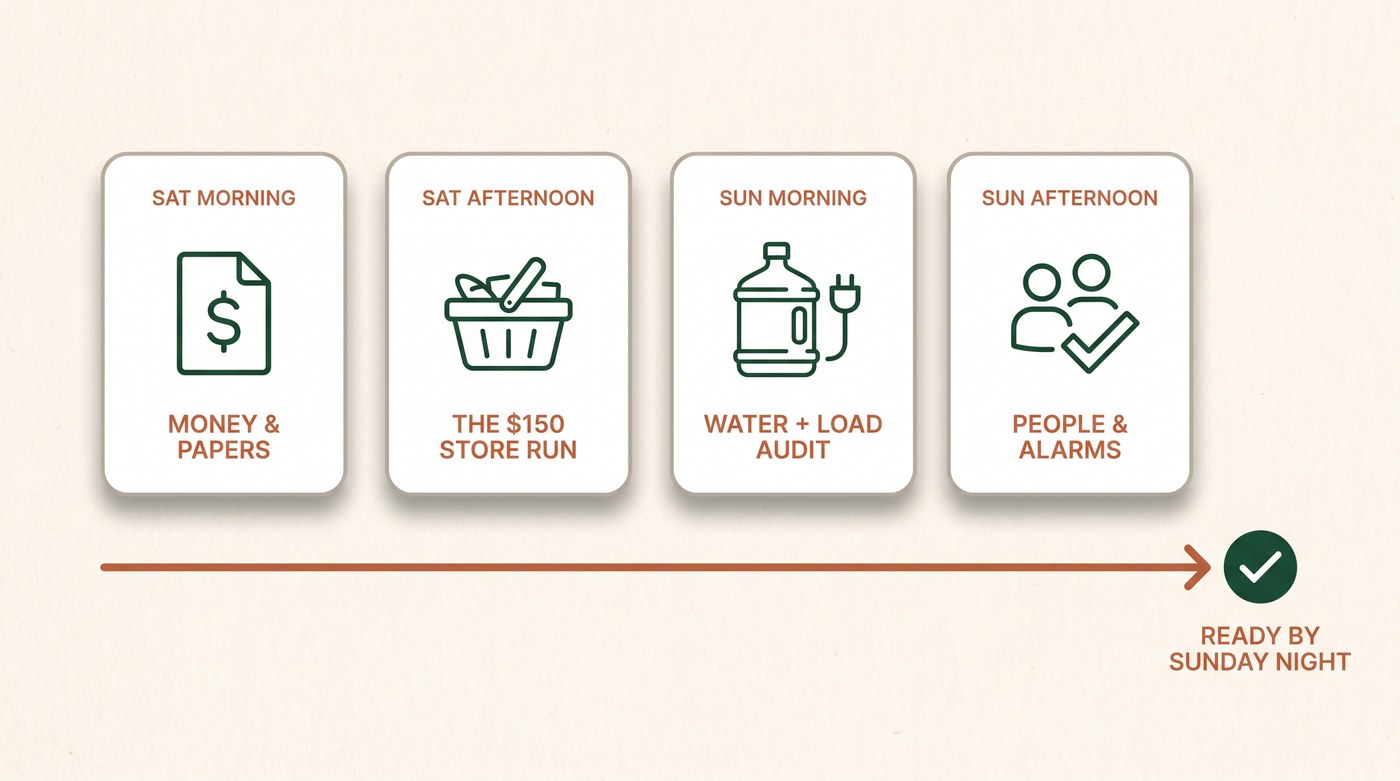
One weekend, ~$150, and the errands you'd half-run anyway. The store run:
| Item | Est. |
|---|---|
| Water — 3-day supply | $20–30 |
| Pantry, first pass | $40 |
| Batteries + lights | $25 |
| First aid kit | $30 |
| CO alarm | $25 |
The First Weekend — 2 days, ~$150, a founded household
"This Tuesday's list"
Every chapter ends with 3–7 items sized to fit inside an ordinary week:
- ☐ Test every smoke and CO alarm — 30 seconds each
- ☐ Find your water shutoff; show one other person
- ☐ $20 in small bills in an envelope — the first brick
- ☐ Note your checking balance for Chapter 2
The weekly lists — 20 chapters, 20 lists, zero heroics required
Real numbers, not fear
The math of being unprepared

You already know this feeling. The 11 PM kitchen-table math. The grocery total that keeps climbing while the paycheck doesn't. The "what if the transmission goes THIS month" knot in your stomach.
That feeling has a name: being one Tuesday behind. And no amount of camouflage gear fixes it — because it was never a gear problem.
Why it's still unsolved
The "survival industry" sells the order backwards
Failed answer #1: the doomsday industrial complex. Bunkers. 25-year buckets of food nobody has ever tasted. $3,000 "tactical" packages. Content that gets more extreme the deeper you scroll. The industry sells gear first, fear always, money never — because gear has margins and worksheets don't.
Failed answer #2: winging it. "We'll figure it out if it happens." That's the plan that panic-buys the wrong backup at 8 AM after a bad night, loses a freezer to an opened door, and puts the surprise bill on a 29% APR card.
What the quietly-prepared actually do

Spend time where experienced preparedness people advise newcomers and you'll notice their most-repeated advice isn't "buy more gear." When a scared newcomer asks where to start, the veterans answer — over and over — with the same order. Here's one widely-read example thread — read the top answers yourself.
(Community advice, quoted as exactly that — not as reviews of this book.)
Prep for Tuesday, not doomsday.The line this book is named after
The order is the strategy:
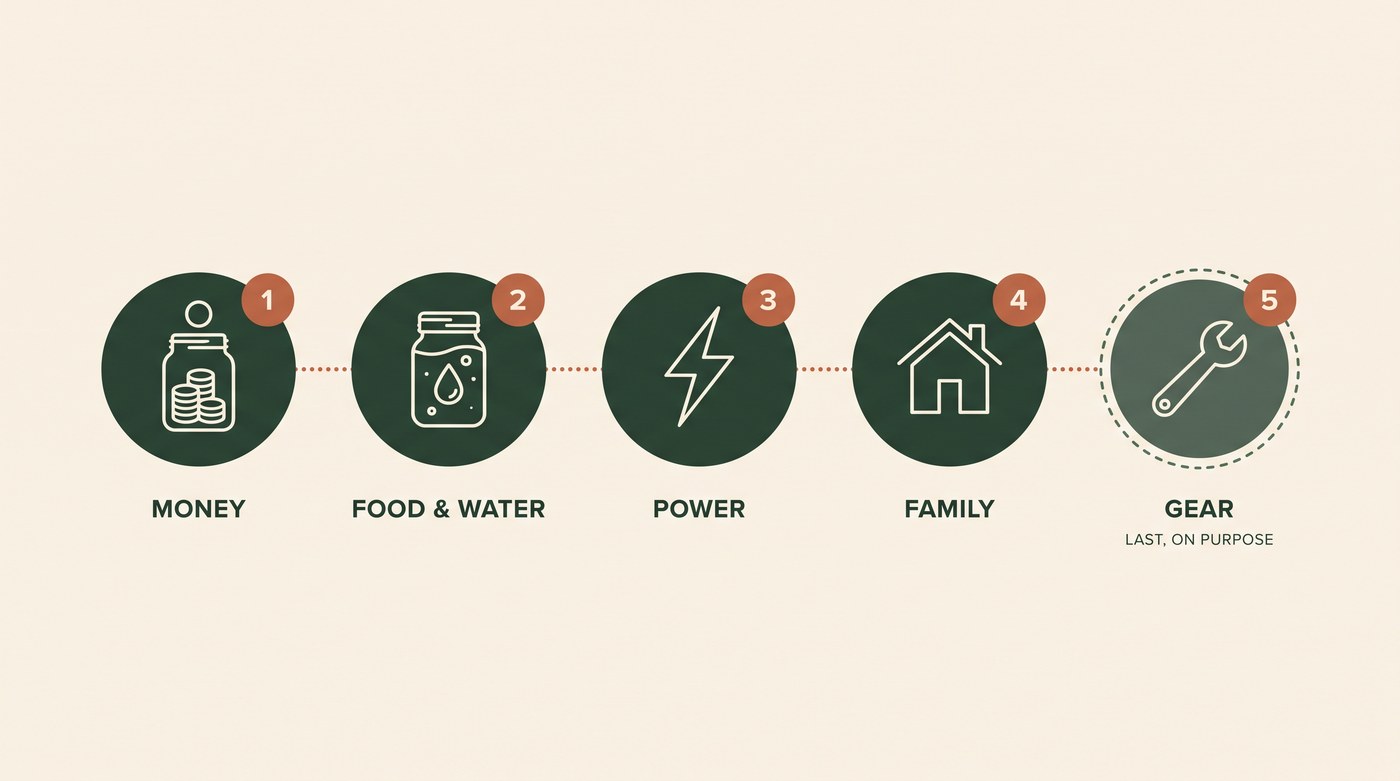
Ready by Tuesday is that community-informed order, turned into a system: 20 chapters, every worksheet pre-built, every safety figure pulled from the official source and cited, every step sized to fit an ordinary week.
Inside the plan
Four parts. One weekend. Exactly what's waiting inside.
Money First: The 30-Day Cushion
Outcome: you know your Real Number — and the cushion funds itself on autopilot.
- Your Real Number — the figure most families have never calculated, that turns "save more" into a finish line (smaller than you fear). See the actual worksheet →
- The $1,000-first sequence that kills the most common family emergency before the emergency fund even exists. Ch. 3
- Sinking funds — how car repairs and deductibles stop being "surprises" at all. Ch. 3
- The insurance gap that shocks more homeowners than any other — standard policies don't cover it. Ch. 4
- The 20-minute beneficiary audit that prevents the paperwork mistake families regret most. Ch. 4
- The Document Go-Folder — 21 papers that decide whether your worst month is a project or an archaeology dig. Ch. 5
Food & Water Without the Bunker
Outcome: a 30-day pantry of food your family actually eats — built on grocery money.
- Copy-Canning — a 30-day pantry of food your family already likes, $10 a week. Worst case: you spent grocery money on groceries. See a real week →
- The exact per-person water math, with disinfection figures quoted straight from the EPA. Ch. 8
- The 5 crops worth growing (skip everything the store sells cheap) — and why fresh herbs quietly beat every other crop on price-per-pound. Ch. 9
- The preservation shortcuts that aren't safe — clearly marked, with USDA-tested versions beside them. Ch. 10
Power & Blackout Readiness
Outcome: one honest number, the right-size backup — and a blackout night your kids remember fondly.
- The Load Audit — 3 questions, one worksheet, your household's real backup number… before the salesman gives you his. See the actual sheet →
- Why the answer is sometimes a $60 power bank — and sometimes "nothing new at all." Ch. 12
- The USDA fridge-and-freezer hours that decide whether an outage costs $40 or $400. See the playbook →
- The one carbon-monoxide rule that makes the deadliest blackout mistake never-you. Ch. 13
- "Heat the person, not the house" — the one-room system that tames a January outage. Ch. 14
- What's honestly a licensed-electrician job — and the spec-sheet lines that matter when you buy. Ch. 15
Skills, Family & the Quiet Basics
Outcome: a practiced household — everyone knows the plan, the card, and the meeting point.
- The family communication card your kids can actually use — and why texts get through when calls don't. Ch. 16
- The 3 first-aid skills genuinely worth hands-on training, and the kit checklist store kits fail. Ch. 17
- The "safe, boring home": alarms, extinguisher, locks, lighting, neighbors-as-infrastructure. Ch. 18
- Your First Weekend — the 2-day, ~$150 sequence that ends with a measurably readier household by Sunday night. Ch. 20
What actually changes — and how fast
Your First Weekend, mapped
Chapter 20 condenses the whole book into one scheduled weekend. This is the real itinerary (read the actual chapter sample):
Introducing
Ready by Tuesday

20 chapters. Around 45,000 words of checklists, worksheets, and exact numbers — zero filler, zero fear. Every safety figure cited to FEMA, USDA, EPA, CDC, CPSC and Red Cross guidance right where you need it. Every chapter ends with a "This Tuesday's list" — or run the whole thing as one focused weekend with Chapter 20.
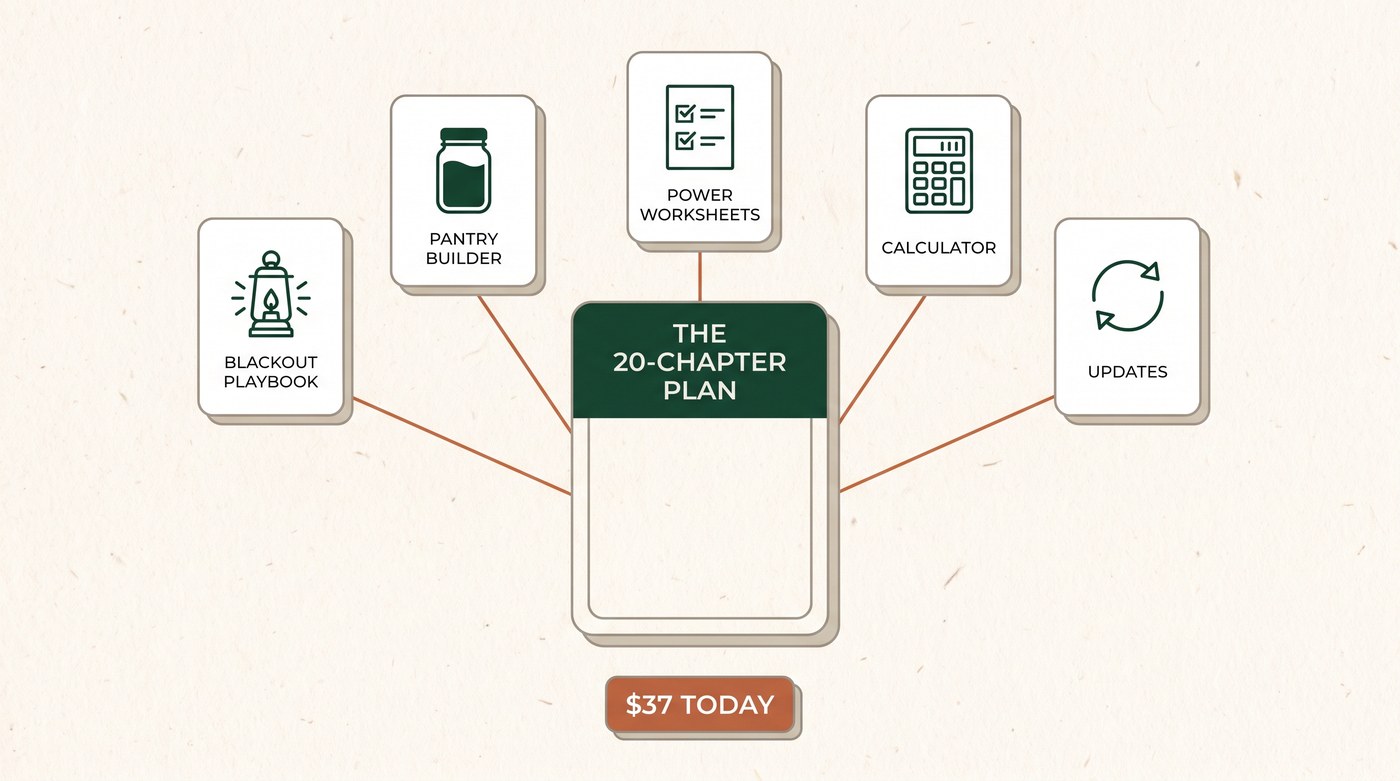
Everything you get today
Regular price: $47
Comparable guides sell for $27–$67 each and cover a single topic. This is the whole system — money, food, water, power, and family — for less than one mistimed trip to the generator aisle.
Read it. Work the first weekend. Then decide.
If Ready by Tuesday doesn't make your household measurably more prepared within 60 days, email one word — "refund" — and you get every cent back. No forms, no questions. And you keep all three bonuses either way. We're comfortable offering that because we're confident in the plan.
Why there are no five-star reviews on this page
This is a new guide, and we don't rent reviews. What we show instead:
- The pages themselves. Five real samples are linked throughout this page — the worksheets, a full chapter, the playbook. Inspect before you buy.
- The sources. Every safety-critical figure is cited to FEMA, USDA, EPA, CDC, CPSC or Red Cross guidance — inline, where you use it. Check any of them.
- The guarantee. 60 days, one email, keep the bonuses.
Who this is for — and who should close this page
| Get it if… | Skip it if… |
|---|---|
| You want your family ready for the realistic stuff: outages, layoffs, storms, brutal grocery months | You want collapse-of-civilization content — this book will genuinely disappoint you |
| You rent, live in an apartment, or have zero land — the plan assumes nothing | You're looking for bunker builds and tactical gear lists |
| You'd rather follow checklists than read theory | You enjoy assembling 100 hours of research yourself (genuinely fine — the sources are public) |
| You have a normal budget — the whole first weekend runs ~$150, mostly groceries | You believe preparedness starts with a $3,000 purchase |
What waiting actually costs
- One spoiled fridge and freezer: commonly $150–$400 of food (estimate — count yours tonight). The prevention is one USDA table in Chapter 13.
- One panic-bought generator at 8 AM after a bad night — when the Load Audit might have pointed to a much smaller power station, or nothing new at all.
- One surprise $400 bill on a 29% APR card because the cushion didn't exist yet — the debt spiral Chapter 3 is built to kill.
- Storm season doesn't reschedule. Outage hours per household have roughly doubled in a decade (EIA, above). Every week unprepared is exposure you're choosing.
Before you decide
Questions people actually ask
Is this doomsday stuff?
No — it's the deliberate opposite. If you want collapse content, this will disappoint you. It's the plan for the disruptions ordinary households are likely to face: money shocks, outages, storms, bad months.
Why is it only $37 if it covers all of this?
Because it's digital, we keep full margin without a publisher, and $37 is the introductory price while the book is new. The planned regular price is $47. No other catch.
Is it a physical book?
Digital (PDF + printable worksheets), delivered instantly to your email and on-screen. Print any page — the playbooks and worksheets are designed for it.
I rent / have an apartment / have no yard.
So does the plan. Nothing in it requires land, a garage, or a landlord's permission. The growing chapter is container-first and clearly optional.
How long does it take?
The First Weekend sequence: 2 days, ~$150, measurable end state. Or 20 minutes a week — every chapter ends with a one-week list.
Is it US-only?
US-first (the agencies cited are US), but the methods — cushion math, copy-canning, the load audit — work anywhere.
What if it's not for me?
60 days, email "refund," done — and keep the bonuses. You're the only person your household's plan has to satisfy.
Two Tuesdays from now
One of two things is true.
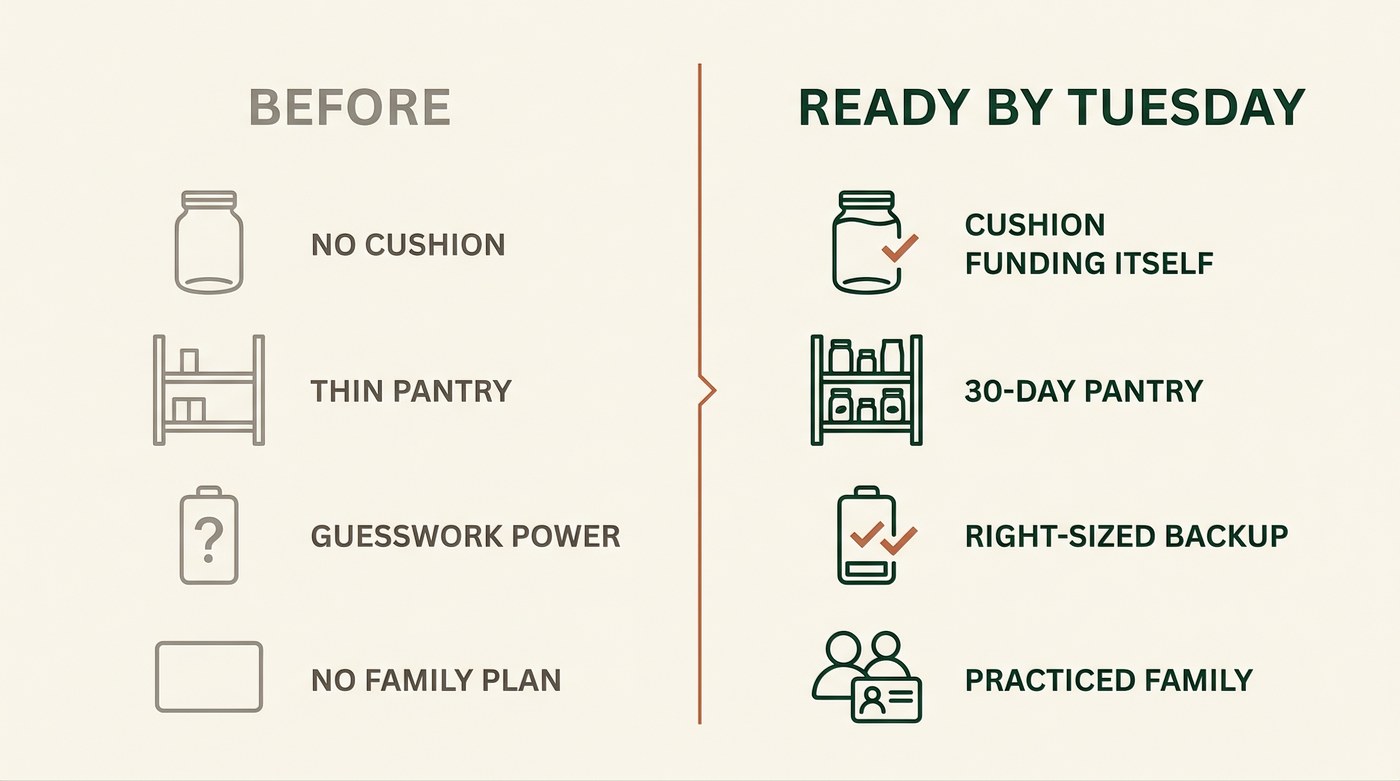
Either your household has a cushion started, three days of water stored, a pantry list running, one honest power number, and a document folder your family could grab in 60 seconds…
…or the next blackout, layoff, or brutal grocery month finds your family exactly as ready as it is tonight.
The plan takes one weekend. The price is one takeout order. The decision takes one click.
P.S. The guarantee makes this simple: work the First Weekend, and if your household isn't measurably readier, the book was free and you keep the bonuses. The only losing move is the one where nothing changes.